
Human Resources
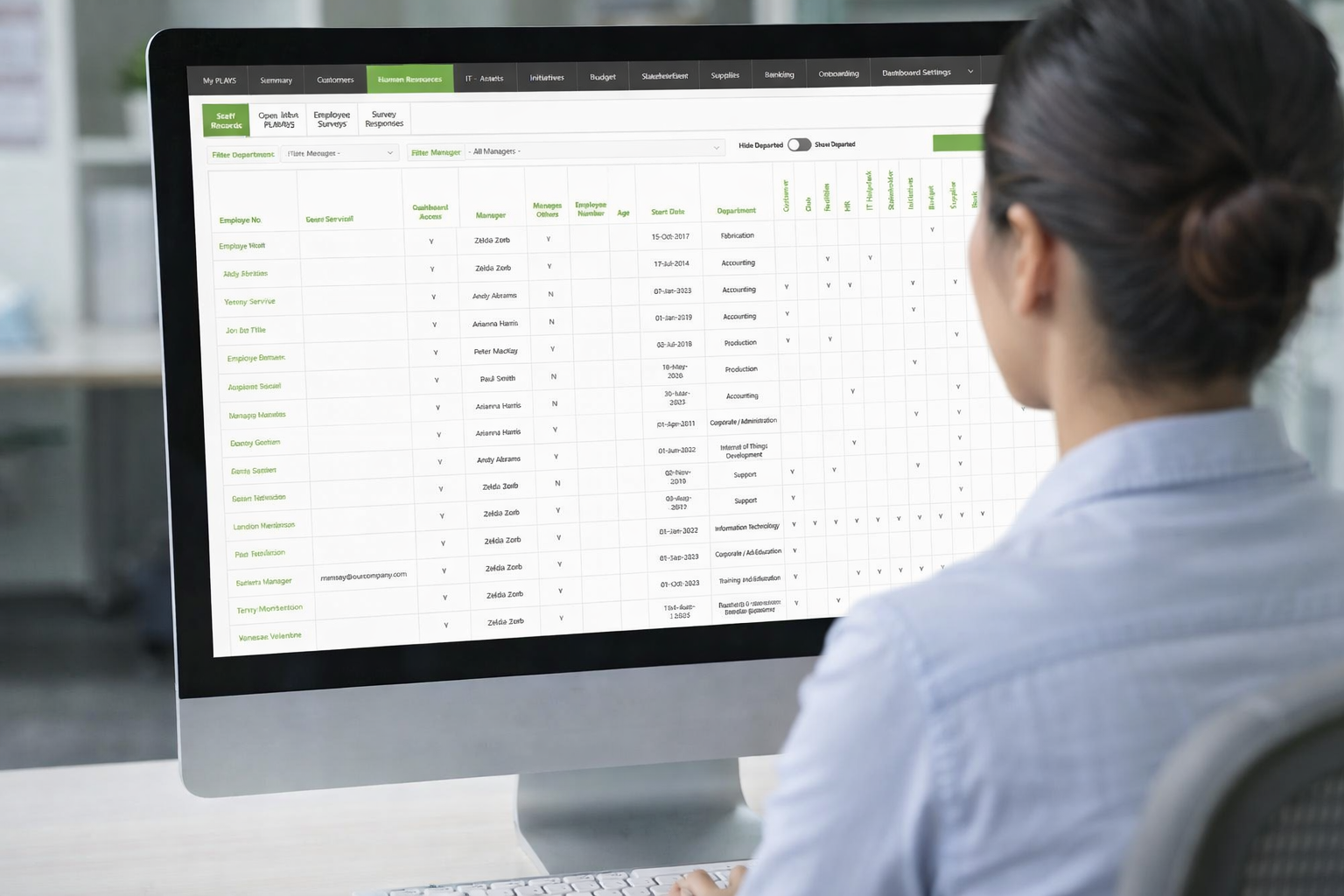
Employee data, leave, hiring, time cards, and a punch clock at the door — with hours booked to the job they were worked on, and without the spreadsheet sprawl.
Almost every timesheet product sells you a rules engine. Opterion-IT does no overtime calculation at all — and that is the feature, not the gap.
Ten hours worked on a Tuesday is not one line the software then interprets. It is an eight-hour Regular line and a two-hour Overtime line, entered by the person who worked them. The system records what your employee said about their own time. It never derives it.
That single decision removes the work-week boundary problem, the union agreement to encode, the compressed four-day schedule, the weekend shift swapped for a Tuesday off, and time taken in lieu. Every one of them is simply a line on a card. Nothing has to be configured, and nothing has to be maintained the next time an agreement changes.
What is left is a record with a very short chain of custody. Only the employee ever edits their own card. A manager approves it or returns it with a reason — never edits it — so nobody can claim their hours were altered. And once a card is approved it is locked against everyone: the employee, the manager who approved it, and HR alike.
The punch clock is built on exactly the same refusal. A tablet by the door reads a fob or a four-digit code, and it records the minute somebody arrived and the minute they left. It does not round those minutes — rounding is a pay rule, and in some jurisdictions a legislated one. It does not assume a punch-out at the end of a notional eight-hour day, because assuming an out time is the software quietly deciding what to pay. And it never says anybody was late, because it holds no roster to be late against. It says when you came and when you went. Everything else is a person's decision, with their name on it.
Corrections still happen — they are appended, signed and attributed, never edited over the top of an approved figure. On the punch clock the machine reading is never overwritten at all: a correction sits beside it, and both are on the screen together.
Location at the job, switched on person by person.
For staff who work at customer sites and tap I've arrived and I'm leaving on their phone.
Per person
The company turns the feature on, then location is switched on for each employee on their own record. The new hire and the twenty-year veteran do not have to get the same answer.
Two moments, not a trail
Recorded when they tap I've arrived and when they tap I'm leaving. Nothing in between — not on lunch, not on the drive home.
They know
When it is on for them, the phone says so on the screen where they arrive and leave. There is no hidden mode.
Refused is refused
Declined, no signal and timed out are recorded as what they were, so nobody is mistaken for somebody who said no.
On the time card, one tap on a visit opens a map: where they arrived on the left, where they left on the right, each with its time and how accurate the phone was.
Other modules to pair with Human Resources
Most purchasing tools show you what is low. Opterion-IT shows you what is low, what a live order needs, why, and by when — in one list, one decision at a time. And the kits you assemble yourself go back on the shelf at what they really cost to build.
Learn moreWhich vehicle is due for what, worked out from the fuel receipts and bills you already record. Services come due by distance, insurance and other renewals by date. No GPS box, no telematics subscription.
Learn moreHardware, software, and licences — accounted for and accountable.
Learn moreSee Human Resources in your data.
30 minutes. See the full workflow end-to-end. No hard sell.